
Your guest data exists. It's just trapped in seven different places.
The PMS holds stay history and room preferences. The booking engine knows what they searched before they booked. Your email platform tracks opens, clicks, and campaign conversions. Review sites capture sentiment. The loyalty program holds points balances and tier status. POS systems log restaurant and spa spend. And your OTA extranets? They hold guest records you may never see again.
Industry surveys consistently find that nearly half of hotels report fragmented technology prevents them from maintaining a unified view of their guests. That's not a minor inconvenience; it means the majority of the industry is running marketing campaigns, service recovery, and upsell programs on incomplete data.
If you've ever exported 40,000 guest records from three systems, spent a week deduplicating in Excel, and still weren't confident the segments were clean enough to act on, you already know the cost of this fragmentation. Not in abstract terms. In hours, missed revenue, and guests who feel like strangers on their fourth stay.
So what does the path from fragmented data to a single guest profile actually look like?
The Seven Systems Problem, and Why It Persists
Most mid-market hotel groups operate with between five and nine guest-facing systems. PMS, booking engine, channel manager, email marketing platform, review management tool, loyalty system, and increasingly some form of messaging or chatbot. Each one captures a slice of who the guest is.
The problem isn't that these systems exist. They're good at what they do. The problem is that none of them were designed to talk to each other in a way that produces a unified guest record.
Your PMS knows a guest stayed three nights in a superior room. Your email platform knows they opened the pre-arrival email but didn't click the spa offer. Your review data shows they mentioned slow check-in on their last visit. But no single system holds all three facts about the same person, which means nobody on your team can act on the full picture.
This is where the concept of a CDP (Customer Data Platform) enters the conversation. Not as a replacement for any of those systems, but as the integration layer that sits on top of them.
What a Hotel CDP Actually Does
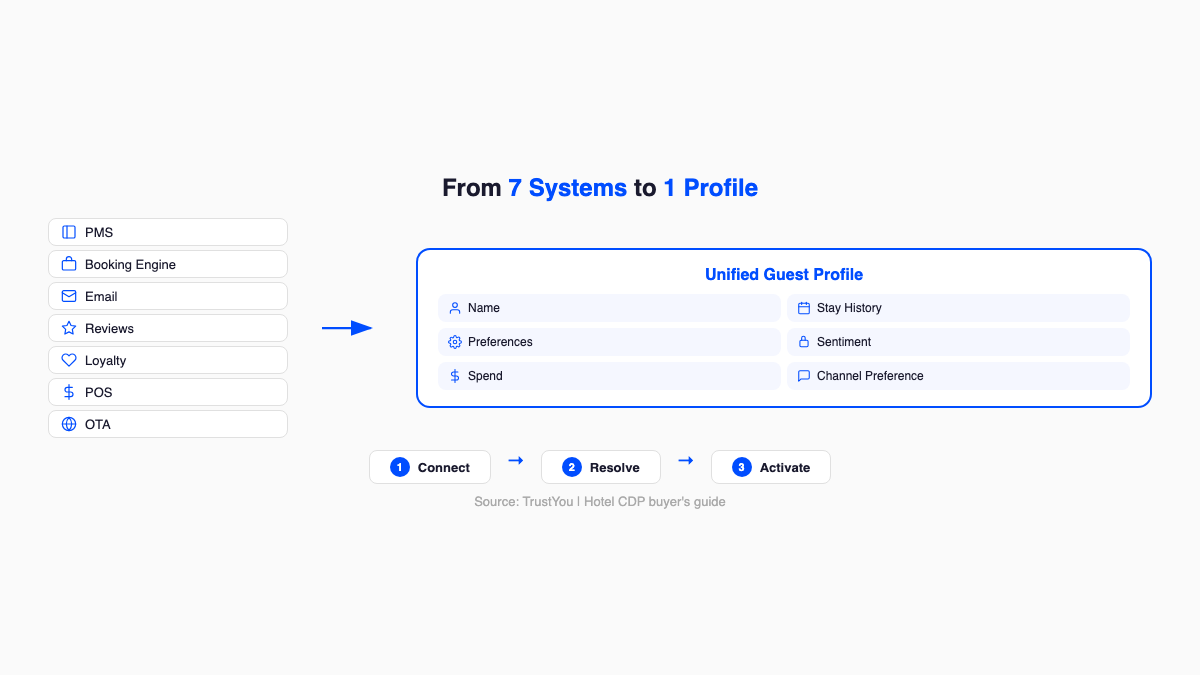
A hotel CDP connects to your existing systems via native integrations and APIs, ingests guest records from each source, and resolves them into deduplicated, unified profiles. Think of it as the connective tissue between tools you already own.
Here's the practical sequence:
Step 1: Connect Your Data Sources
Start with the three highest-value sources: your PMS (stay history, room preferences, spend), your booking engine (search behavior, booking patterns, direct vs. OTA origin), and your email platform (engagement, campaign response, opt-in status). These three alone give you a profile that's dramatically more useful than what any single system provides.
From there, layer in review data (sentiment, recurring complaints, praise patterns), loyalty data (tier, points, redemption behavior), and POS data (ancillary spend: F&B, spa, activities).
Step 2: Resolve and Deduplicate
Guest records are messy. The same person might appear as "J. Mueller" in Opera, "Julia Mueller" in Mailchimp, and "julia.mueller@gmail.com" on Booking.com. A CDP uses identity resolution, matching on email, phone, booking reference, and behavioral signals, to merge these into a single profile.
This is the step that saves your CRM manager from the Monday morning deduplication ritual. And it's the step most PMS and email platforms simply can't do, because they only see their own data.
Step 3: Enrich and Segment
Once profiles are unified, you can build segments that were previously impossible. Returning guests who haven't booked direct. High-sentiment guests who've never joined the loyalty program. Guests who always book spa services but have never received a spa offer. Business travelers who shift to leisure stays in summer.
These aren't hypothetical segments. They're the ones that drive measurable revenue, because they're based on behavior across every touchpoint, not just the last email click.
What You Can Do with a Unified Guest Profile
Data unification isn't the goal. It's the foundation. Here's what it enables.
Personalized pre-arrival communication. When you know a returning guest prefers a high floor, booked direct last time, and left a positive review mentioning the breakfast, your pre-arrival email can reference all of that. Not a generic "Welcome back." A message that proves you know them.
Targeted upsell with real context. A guest who spent EUR 180 on room service across two stays is a strong candidate for the half-board package. A guest who has booked three city-center properties is likely interested in your newest urban location. Without a unified profile, these patterns are invisible.
Review-informed service recovery. If a guest's most recent review mentioned a noisy room, your front desk can proactively assign a quiet-side room on their next stay, before they ask. That's the kind of operational intelligence that turns a detractor into a loyalist.
Loyalty identification without a loyalty program. Many mid-market groups don't have formal loyalty programs. But a CDP reveals loyalty behavior: repeat bookings, increasing spend, direct channel preference. You can recognize and reward these guests even without points and tiers: through personalized offers, room upgrades, or simply by greeting them by name.
Hotels with unified CDPs see meaningfully higher email campaign conversion rates than those relying on PMS-based guest lists. That's not because the emails are better written. It's because the segments are built on complete data instead of fragments.
Why the Answer Isn't Rip-and-Replace
Here's what matters for hotel groups evaluating this path: you don't need to replace your PMS. You don't need to migrate off your email platform. You don't need a 12-month IT project.
A CDP sits on top of what you already have. It connects to Opera, Mews, protel, Apaleo, whatever PMS you're running. It pushes clean segments to Mailchimp, HubSpot, or Braze. It enriches, it doesn't replace.
TrustYou's CDP was built specifically for this use case: mid-market hotel groups with five to nine systems that need unification without upheaval. Native PMS integrations, Mailchimp and HubSpot connectors out of the box, and a guest profile structure designed for hospitality data (not retrofitted from retail or e-commerce).
The typical deployment connects three to four core systems in the first month, with additional sources layered in over the following quarter. That's not a transformation project. It's an integration project, and the difference matters when you're trying to get buy-in from IT and a green light from finance.
The Fragmentation Tax Is Real
Every month your guest data lives in separate systems, your marketing team is making decisions on incomplete information. Campaigns go to the wrong segments. Upsell opportunities are missed because nobody can see the full spending pattern. Returning guests get treated like first-timers.
The hotel groups moving fastest on this aren't the ones with the biggest budgets. They're the ones where a Head of Digital Marketing or CRM Manager decided that the weekly data reconciliation ritual had to stop -- and found a way to unify without asking for a six-figure IT project.
That path exists. And it starts with connecting three systems.
See TrustYou CDP in action.
Book a personalized walkthrough to see how your guest data comes together in a single profile.
Book a Walkthrough →Related Reading
Frequently Asked Questions
What is a hotel CDP and how is it different from a CRM? A hotel CDP (Customer Data Platform) ingests and unifies guest data from multiple systems (PMS, booking engine, email, reviews, loyalty) into a single guest profile. Unlike a CRM, which primarily stores contact records and tracks sales interactions, a CDP focuses on behavioral data unification and audience segmentation for marketing activation.
How many systems does a hotel CDP typically connect to? Most mid-market hotel groups start by connecting three to four core systems: PMS, booking engine, and email platform. Over time, they add review data, loyalty systems, POS, and OTA data. TrustYou CDP supports native integrations with major hotel PMS platforms including Opera, Mews, protel, and Apaleo, plus marketing tools like Mailchimp and HubSpot.
How long does it take to implement a hotel CDP? TrustYou CDP typically connects three to four core data sources within the first month, with additional systems layered in over the following quarter. This is an integration project, not a platform migration. It sits on top of your existing tech stack without replacing any systems.
What results do hotels see from guest data unification? Hotels with unified CDPs see meaningfully higher email campaign conversion rates than those relying on PMS-based guest lists. Unified profiles enable personalized pre-arrival communication, targeted upsell based on complete spending history, review-informed service recovery, and loyalty identification without formal loyalty programs.
Does implementing a CDP mean replacing our PMS or email platform? No. A CDP is an integration layer that connects to your existing systems via native integrations and APIs. TrustYou CDP works with your current PMS, booking engine, and email platform. It unifies and enriches your data without requiring any system migration.
How does TrustYou CDP compare to Revinate or other guest data platforms? TrustYou CDP is purpose-built for mid-market hotel groups at approximately 60% of the cost of legacy alternatives like Revinate. It offers native PMS integrations, AI-powered data enrichment, and out-of-the-box connectors to Mailchimp and HubSpot, with a quarterly AI feature release cadence that legacy vendors don't match.