
TL;DR
- Hotels invest in great email tools like Mailchimp, but most campaigns underperform because the guest data feeding them is incomplete, fragmented, or stale.
- Only 24% of hotels have fully integrated core systems. The rest rely on manual exports, disconnected databases, and guesswork.
- Segmented email campaigns see 100% higher click-through rates than non-segmented ones, according to Mailchimp's own data. Automated email flows generate nearly 16x more revenue per send than manual campaigns.
- The fix isn't a better email tool. It's connecting your guest data so the tool you already have can do what it was built to do.
In this article
- Why are hotel email campaigns underperforming?
- What happens when your PMS doesn't talk to your marketing tools?
- What would your campaigns look like with a complete guest profile?
- What does a fully connected guest journey look like?
- What's the revenue impact?
- How hotels are connecting their guest data to Mailchimp
- FAQ
Why Are Hotel Email Campaigns Underperforming?
Hotels spend thousands on Mailchimp. The templates are polished, the automations are set up, the list keeps growing. But the results don't match the investment.
Travel and hospitality has the lowest email open rate of any industry at 30.1%, according to MailerLite's 2025 benchmarks. Click-through rates sit at just 1.4% across the sector, per Campaign Monitor's analysis of over 100 billion emails.
The gap between what hotel email marketing could deliver and what it actually delivers is enormous. And the problem isn't the email platform.
It's what's feeding it.
Industry Benchmark
30.1%
Travel & hospitality has the lowest email open rate of any industry
What Happens When Your PMS Doesn't Talk to Your Marketing Tools?
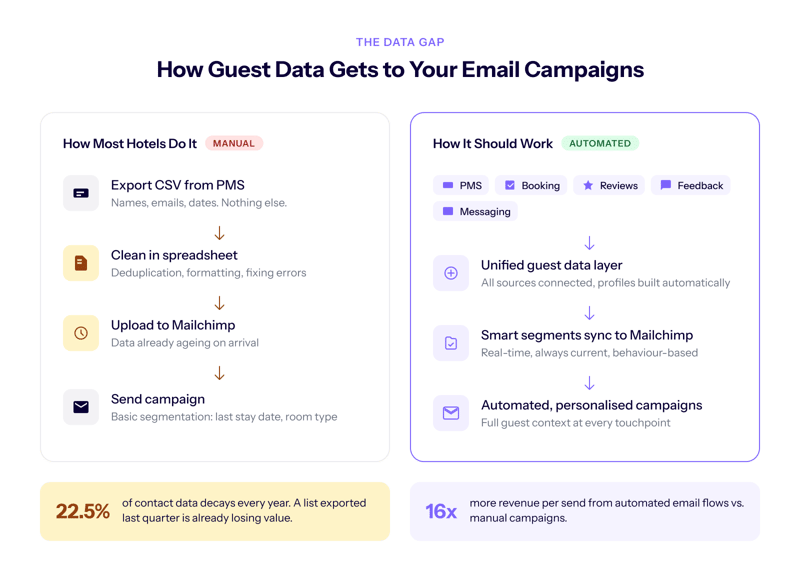
Here's what guest email marketing looks like at most hotels today:
The Typical Hotel Email Workflow
1
Someone exports a CSV from the PMS
2
They clean it up in Excel — remove duplicates, fix formatting, fill gaps
3
They upload it to Mailchimp
4
They build a campaign with whatever data survived the process
By the time the email goes out, the data is already degrading. B2B contact data decays at roughly 22.5% per year. Guest data moves even faster: people change email addresses, phone numbers, preferences. A list exported last quarter is already losing value.
But the real cost isn't just stale data. It's fragmented data.
The average hotel runs on 2 to 5+ disconnected systems: PMS, booking engine, channel manager, review platform, guest messaging tools. Only 24% of hotels have fully integrated their core systems, according to Starfleet Research. The other 76% are working with data that lives in silos.
System Integration
Only 24%
of hotels have fully integrated their core systems
The other 76% are building campaigns from fragmented data
Source: Starfleet Research
That means the marketing team is building campaigns without access to:
- Guest feedback and review sentiment
- Booking history and stay preferences
- Communication history across channels
- Loyalty indicators and spend patterns
They have names and email addresses. Not guest profiles.
Marketing teams spend an average of 6 to 10 hours per week just collecting and preparing data, with 63% of that time going to tasks that could be automated. In hospitality specifically, disconnected systems waste an estimated 13-19% of operating costs on inefficiency and duplication.
What Would Your Campaigns Look Like With a Complete Guest Profile?
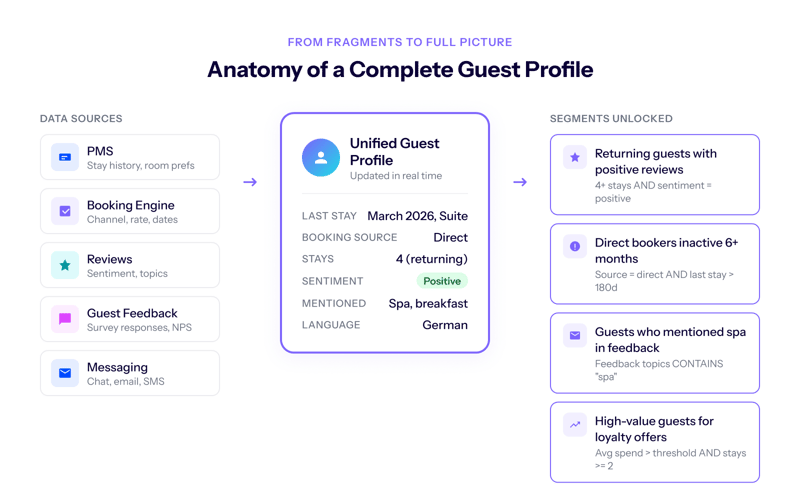
Imagine your Mailchimp had access to everything you know about a guest, not just their name and last stay date, but:
- Which room type they prefer and what they've booked before
- Whether their last review was positive or negative (and what they mentioned)
- Whether they booked direct or through an OTA
- Their communication preferences and language
- How much they typically spend on ancillary services
That's a guest profile. And it changes what's possible in your email campaigns.
The numbers here are not subtle. Mailchimp's own data shows that segmented campaigns see 14% higher open rates and 101% higher click-through rates compared to non-segmented ones, based on an analysis of 11,000 campaigns. And Campaign Monitor found that segmented campaigns can drive up to a 760% increase in revenue.
Personalised subject lines alone increase open rates by 26%. And 71% of consumers now expect companies to deliver personalised interactions, with 76% getting frustrated when it doesn't happen, according to McKinsey.
There's a massive gap between what guests expect and what hotels deliver. The data infrastructure to close it exists — most hotels just haven't connected it yet.
What Does a Fully Connected Guest Journey Look Like?
Most hotel email marketing is episodic. A campaign goes out when someone remembers to send one. There's no connection between the pre-booking stage, the stay, and the post-stay follow-up.
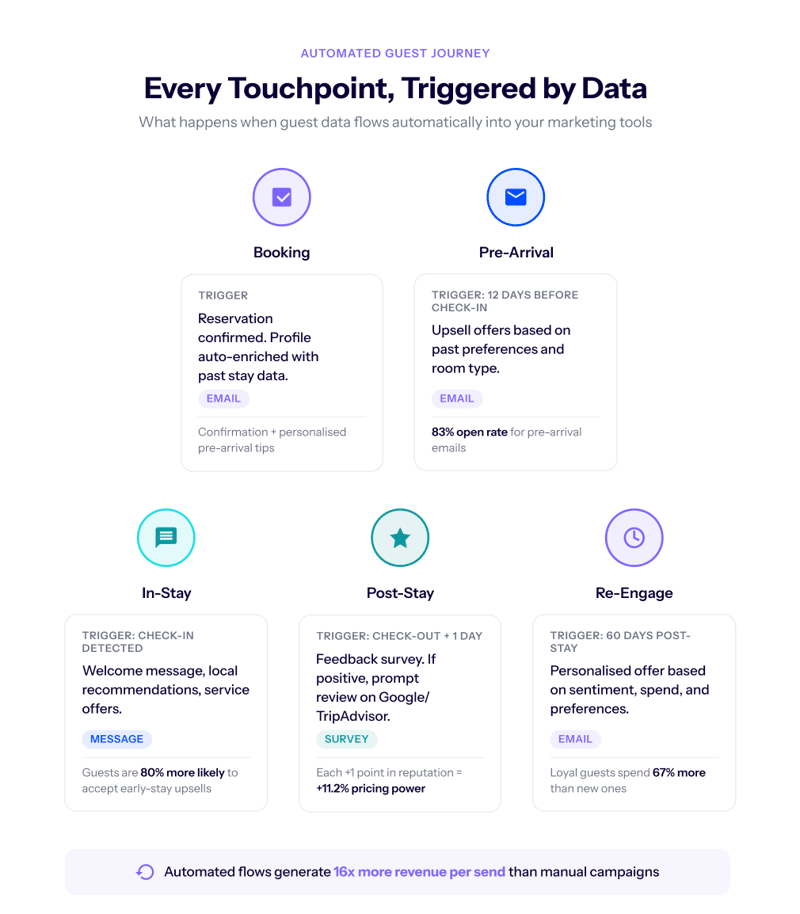
Now consider what happens when guest data flows automatically into your marketing tools:
- Booking confirmed → Automated pre-arrival email, personalised based on past stays and preferences. Pre-arrival upselling emails achieve an 83% open rate and 13% conversion rate. Sending them 12 days before check-in drives the highest engagement.
- During the stay → Targeted messages based on guest profile and real-time context. Guests are 80% more likely to accept an upsell during the pre-arrival and early stay stages.
- Post-stay → Automated feedback request, followed by a review prompt if the guest had a positive experience. Then a re-engagement campaign at the right interval.
- 60 days later → A personalised offer based on their stay history, preferences, and sentiment.
This isn't a fantasy workflow. It's what automated, data-connected email marketing looks like. And the performance difference is dramatic: automated email flows generate $2.87 per email versus $0.18 for manual campaigns, nearly 16 times more revenue per send, according to Omnisend's analysis. Automated messages see 52% higher open rates and 332% higher click-through rates.
The entire journey runs through Mailchimp. But it's powered by connected guest data.
Want to see how this works with your systems?
Explore TrustYou CDP →
What's the Revenue Impact?
Connected guest data doesn't just improve email metrics. It shifts the revenue model.
OTA Booking
$320
15–25% commission
→
Direct Booking
$519
60%+ more value
Direct bookings are worth more. Every guest you can reach directly through email is a guest you're not paying 15–25% OTA commission on.
Personalisation drives measurable revenue lift. McKinsey's research shows personalisation typically drives a 10-15% revenue increase, with top performers seeing up to 25%. Companies that grow faster drive 40% more of their revenue from personalisation than slower-growing competitors.
Retention compounds. Acquiring a new guest costs 5-25 times more than retaining an existing one. A 5% increase in customer retention can drive a 25-95% increase in revenue, per Bain & Company's foundational research. Loyal hotel guests spend 67% more than new ones, according to CBRE.
You don't need a loyalty programme to build loyalty. Hotel loyalty membership reached 675 million in 2024, but points-based programmes are out of reach for most independent hotels. Connected guest data creates the same effect, recognise returning guests, personalise their experience, give them a reason to book direct next time. That's a data problem, not a software problem.
The Revenue Impact
What Connected Guest Data Unlocks
| Without Connected Data | With Connected Data | |
|---|---|---|
| Direct Booking Value | $320 avg OTA booking 15-25% commission per booking | $519 avg direct booking 60%+ more value per booking |
| Email Campaign Revenue | $0.18 per email Manual, one-off campaigns | $2.87 per email 16x more from automated flows |
| Personalisation Lift | Generic campaigns Basic segmentation by stay date | 10-15% revenue increase 73% more revenue per recipient |
| Guest Retention | 5-25x costlier to acquire New guests with no re-engagement | 67% higher spend from loyal guests +5% retention = up to 95% more revenue |
How Hotels Are Connecting Their Guest Data to Mailchimp
The gap between having an email tool and having the data to power it is the single biggest bottleneck in hotel marketing today.
Closing that gap means connecting your PMS, booking systems, guest feedback, and communication channels into one guest data layer, and then letting that data flow into Mailchimp automatically. No CSV exports. No manual segmentation. No stale lists.
That's what a Customer Data Platform does. And it's why hotels that connect their systems see step-change improvements in campaign performance, guest satisfaction, and direct revenue.
TrustYou's CDP unifies your PMS, booking engine, review platform, and guest feedback into a single guest profile, then syncs segments directly to Mailchimp so your campaigns always run on complete, current data.
Ready to connect your guest data?
See How TrustYou CDP Works →Frequently Asked Questions
Can I connect my PMS to Mailchimp?
Yes, using a Customer Data Platform (CDP). A CDP sits between your PMS and your marketing tools, syncing guest data automatically. Instead of manual CSV exports, it pulls guest profiles from your PMS, enriches them with data from other sources (reviews, feedback, booking history), and pushes segments to Mailchimp in real time.
What is a hotel Customer Data Platform?
A hotel CDP collects guest data from multiple sources (PMS, booking engine, review platforms, feedback tools, messaging channels) and unifies it into a single guest profile. This profile powers segmentation, personalisation, and automated communication across your marketing stack.
How do hotels personalise guest email marketing?
Effective personalisation requires more than a first name in the subject line. Hotels that personalise well use unified guest profiles to segment by stay history, booking behaviour, feedback sentiment, and preferences. These segments power automated journeys: pre-arrival upsells, post-stay follow-ups, loyalty campaigns, and re-engagement sequences.
What data do I need for guest segmentation?
At minimum: stay history, booking source (direct vs. OTA), and guest contact details. For meaningful segmentation, you also want review sentiment, feedback responses, spend patterns, communication preferences, and loyalty indicators. The more data sources you connect, the more precise your segments become.