
Your operations team wants an AI agent. Your digital team has already shortlisted vendors. But the proposal sitting on your desk is missing the one thing you actually need: a credible business case with numbers finance can verify.
This is the gap that kills hotel technology projects. Not skepticism about AI itself, but the absence of a rigorous ROI model that translates operational impact into P&L language. Nearly half of hotels report that fragmented technology prevents them from maintaining a unified view of their guests, and the inability to quantify the cost of that fragmentation is a major reason technology investments stall at the budget approval stage.
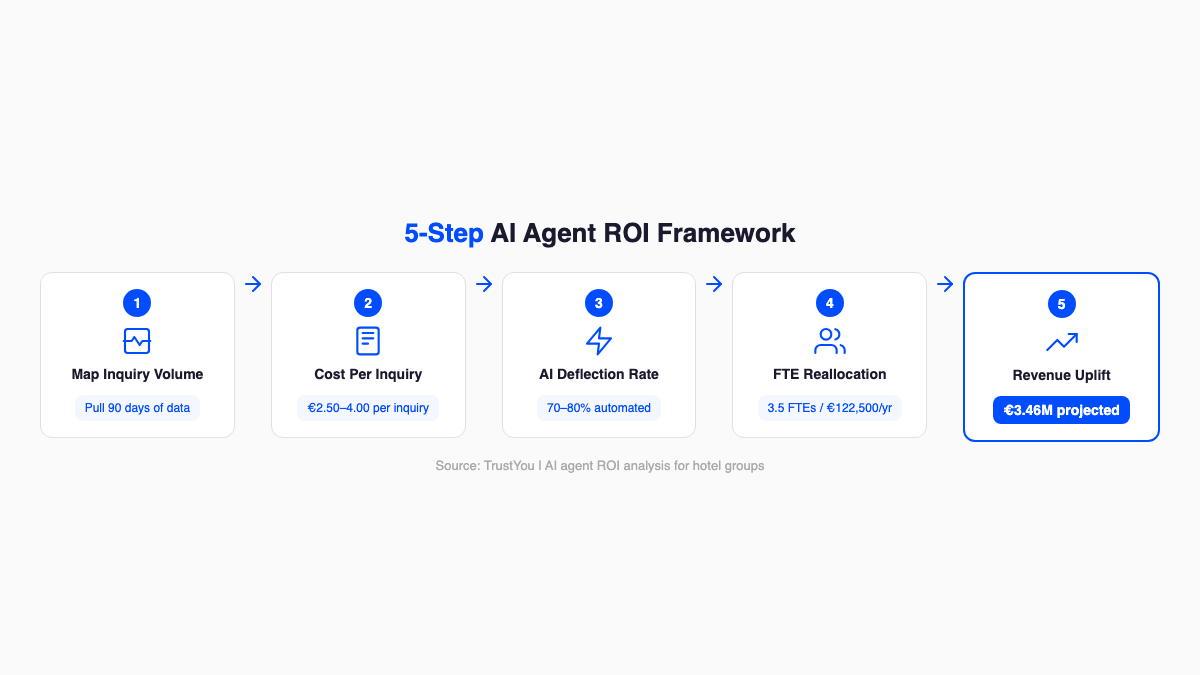
Here's a five-step framework for modeling AI agent ROI that your finance team can pressure-test. Every input is something your operations team already knows. Every output maps to a line item your CFO already tracks.
Step 1: Map Your Current Guest Inquiry Volume
Start with what you know. Pull 90 days of data from your front desk, email inbox, WhatsApp, website chat, and booking engine contact forms. Most mid-market hotel groups are surprised by the total when they see it consolidated for the first time.
You need three numbers per channel:
- Total inquiry volume (messages, not conversations; one guest might send four messages about parking, breakfast, and checkout time)
- Response rate, meaning what percentage actually gets a reply within the channel
- Average response time, from guest message to first human reply
That third number matters more than most operators realize. Most guests now expect a response within minutes. If your average email response time is four hours and your WhatsApp sits unmonitored after 10pm, you already know where the leakage is.
The Monday morning version of this exercise usually involves pulling data from three or four systems and manually stitching it together in a spreadsheet. That process itself is a cost, but it also means most hotel groups don't actually know their true inquiry volume. They know what the front desk handled. They don't know what they missed.
Step 2: Calculate Your True Cost Per Inquiry
This is where the business case gets specific. Take your front desk and reservations labor cost (fully loaded, including benefits and training) and divide it by the number of guest inquiries handled per month.
For a mid-market hotel group running 15-30 properties, the math typically looks like this:
- Average fully loaded cost per FTE handling guest inquiries: EUR 35,000/year
- Inquiries handled per FTE per day: 40-60 (varies wildly by channel and complexity)
- Effective cost per inquiry: EUR 2.50-4.00
But that's only the direct cost. The real number is higher because it doesn't account for:
- Missed inquiries, messages that never got a reply because nobody was on shift
- Delayed responses that resulted in the guest booking elsewhere
- Opportunity cost: every minute a reservations agent spends answering "Do you have parking?" is a minute they're not converting a booking inquiry into a confirmed reservation
Revenue directors don't care about data architecture. They care about the line on the P&L that says "lost bookings." When you model cost per inquiry, include the revenue you're not capturing alongside the labor you're spending.
Step 3: Model the AI Agent Deflection Rate
Not every inquiry needs a human. The question is: what percentage can an AI agent handle autonomously, end to end, without escalation?
Based on TrustYou's deployment data across mid-market hotel groups, an AI agent powered by actual guest data, not just a pattern-matching FAQ bot, handles 70-80% of routine guest inquiries without human intervention. That range holds across languages, channels, and time zones.
The key qualifier there is "powered by actual guest data." An AI agent that knows a returning guest's room preference, dietary requirements, and booking history can handle a pre-stay conversation that a generic chatbot cannot. That's the difference between deflecting a question and actually resolving a need.
For your model, use 70% as the conservative assumption and 80% as the optimistic case. Run both.
Step 4: Calculate FTE Reallocation Value
Here's where finance leaders tend to push back, and rightly so. "FTE savings" doesn't mean you fire three people. It means you redeploy the hours those three people currently spend on repetitive inquiry handling toward work that actually requires human judgment.
The math for a 37-property European group:
- AI agent deflects 70-80% of routine inquiries
- Equivalent labor saved: 3.5 FTEs across the portfolio
- Annualized value: EUR 122,500/year (at EUR 35,000 fully loaded cost per FTE)
- Per-property impact: EUR 2,760/property/year in redeployed labor value
Those 3.5 FTEs don't disappear from the org chart. They shift from answering "What time is checkout?" for the 200th time this month to handling complex guest requests, managing VIP arrivals, or converting high-value booking inquiries that require a human touch. The reallocation framing matters because it's honest, and because it's what actually happens in practice.
Which raises the obvious question: what do those redeployed hours produce?
Step 5: Add the Revenue Uplift
Cost savings are only half the model. The other half, and typically the larger half, is incremental revenue the AI agent generates directly.
TrustYou's AI Agent operates as a booking agent, not just a messaging tool. When a potential guest asks about availability at 2am, the AI agent doesn't just answer the question. It presents room options, offers upgrades, and completes the booking on the hotel's direct channel, with zero OTA commission.
For one mid-market European group's 37-property portfolio, the projected revenue impact breaks down as follows:
- Direct bookings captured by the AI agent (inquiries that would otherwise have been lost or routed to an OTA): modeled at a 5% conversion rate increase
- Upsell revenue from pre-stay communication (room upgrades, late checkout, breakfast packages): captured through AI-powered guest profile data
- Projected incremental revenue: EUR 3.46M/year across the portfolio
That EUR 3.46M figure comes from a real business case model, built on the group's actual property count, ADR, and booking patterns. Your number will be different, but the methodology is the same, and the inputs are all numbers your revenue team already has.
"How Do I Know These Numbers Are Real?"
Fair question. Any vendor can build a slide deck with impressive projections. Here's how to pressure-test an AI agent ROI model:
Ask for the inputs, not just the outputs. A credible vendor will walk you through every assumption — inquiry volume, deflection rate, average booking value, commission savings — using your data, not industry averages. If someone hands you a single ROI number without showing the calculation, that's a red flag.
Run a phased pilot. Deploy across two or three properties first. Measure actual deflection rates, actual response times, actual booking conversions over 60-90 days. Compare those numbers against the model's predictions. If the model is within 15% of reality after 90 days, you have your proof point.
Separate cost savings from revenue uplift. The FTE reallocation math is verifiable from day one; you can measure exactly how many inquiries the AI agent handles and calculate the labor equivalent. Revenue uplift takes longer to validate because booking attribution requires tracking over a full booking cycle.
Benchmark against the alternative. The real comparison isn't "AI agent vs. no AI agent." It's "AI agent vs. hiring two more reservations agents and still not covering the 2am shift." When you model the status quo forward, the cost of doing nothing becomes concrete.
Build Your Business Case
The framework above gives you everything you need to model AI agent ROI for your specific portfolio. The inputs are straightforward: inquiry volume, FTE costs, deflection rates, average booking value, and OTA commission rates. The outputs map directly to your P&L.
If you want to skip the spreadsheet and get a custom ROI model built on your portfolio's actual numbers, we'll walk through the model together, every assumption transparent, every input yours.
Get a custom ROI model for your portfolio.
We'll build the business case on your actual numbers — property count, ADR, inquiry volume, and OTA mix.
Request a ROI Assessment →Related Reading
Frequently Asked Questions
How much can an AI agent save a hotel group in FTE costs?
TrustYou's AI Agent saves mid-market hotel groups an average of 3.5 FTEs across a 37-property portfolio, equivalent to EUR 122,500 per year in redeployed labor value. The exact savings depend on your inquiry volume, current staffing model, and the percentage of inquiries the AI agent handles autonomously (typically 70-80%).
What is the ROI of AI agents in hotels?
For a mid-market hotel group, AI agent ROI combines two elements: labor cost reallocation (EUR 2,760 per property per year based on a 37-property European deployment) and incremental direct booking revenue. One mid-market European group's business case projected EUR 3.46M in incremental annual revenue from AI-powered guest communication and direct booking conversion.
How do AI hotel agents differ from chatbots?
An AI agent powered by guest data (booking history, preferences, past feedback) resolves guest needs rather than just deflecting questions. Unlike FAQ-based chatbots that pattern-match keywords, TrustYou's AI Agent accesses the guest's profile to personalize responses, complete bookings, and offer relevant upsells across every channel and language, 24/7.
How long does it take to see ROI from a hotel AI agent?
FTE reallocation savings are measurable within the first 30 days of deployment, as inquiry deflection rates are trackable immediately. Revenue uplift from direct bookings and upsell conversion typically requires 60-90 days to validate across a full booking cycle. Most hotel groups run a phased pilot across two to three properties before portfolio-wide rollout.
Can hotel AI agents handle inquiries in multiple languages?
TrustYou's AI Agent operates in every language across all channels (web chat, WhatsApp, email, and messaging platforms) 24 hours a day. This is particularly valuable for hotel groups in multilingual markets like DACH and Southeast Asia, where staffing native speakers for every language and every shift is operationally impractical.