

It's Monday morning. Your quality manager opens a spreadsheet exported from the review platform, cross-references it with last month's survey results in a separate tab, and starts building the same pivot table she builds every week. Two hours later, she has a rough picture of guest sentiment across 15 properties. Rough, because the data is already 10 days old and missing anything posted over the weekend.
Sound familiar? You're not alone. Across mid-market hotel groups, the process of turning guest feedback into actionable insight still looks remarkably like it did in 2015. Export. Filter. Pivot. Interpret. Forward a PDF to the GM, who skims it on Thursday and acts on it never.
The data exists. Thousands of reviews, survey responses, and competitive benchmarks sit in platforms your team already pays for. But the distance between that raw data and a decision that improves the guest experience? It's measured in days, sometimes weeks, and in the bandwidth of whoever has the patience to dig through it.
Why Guest Feedback Data Stays Trapped
The problem isn't a lack of data. Hotels generate more guest signal than ever: reviews on Google, Booking.com, and TripAdvisor; post-stay surveys; in-stay pulse checks; OTA scores; social mentions. According to TrustYou's analysis of data from 100,000+ hotel properties, the average mid-market group collects feedback from eight or more distinct sources.
The problem is access. That feedback lives behind dashboards designed for monitoring, not exploration. Want to know what guests at your Barcelona property are saying about breakfast this month versus last quarter? That's a custom report. Need to compare noise complaints across your city-center properties to decide where to invest in soundproofing? That's an afternoon with Excel.
Most hotel teams don't have a dedicated BI analyst sitting next to the guest experience team. The people who need the answers (GMs, marketing leads, revenue directors, regional VPs) are the last ones to get them. By the time a trend surfaces in a monthly PDF, the operational window to fix it has closed.
The Shift: Feedback You Can Talk To
Here's where things have changed. Natural language querying, the ability to ask your data a question in plain English and get an immediate, structured answer, is no longer experimental. It's production-ready, and it works on the messy, multi-source, multi-language dataset that hotel guest feedback actually is.
TrustYou CXP's Talk-to-Data capability lets anyone on your team query the full breadth of your guest feedback (reviews, surveys, competitive benchmarks) without building a report, exporting a file, or waiting for someone else to pull the numbers.
You type a question. You get an answer. With sentiment breakdowns, property comparisons, time-range analysis, and source attribution baked in.
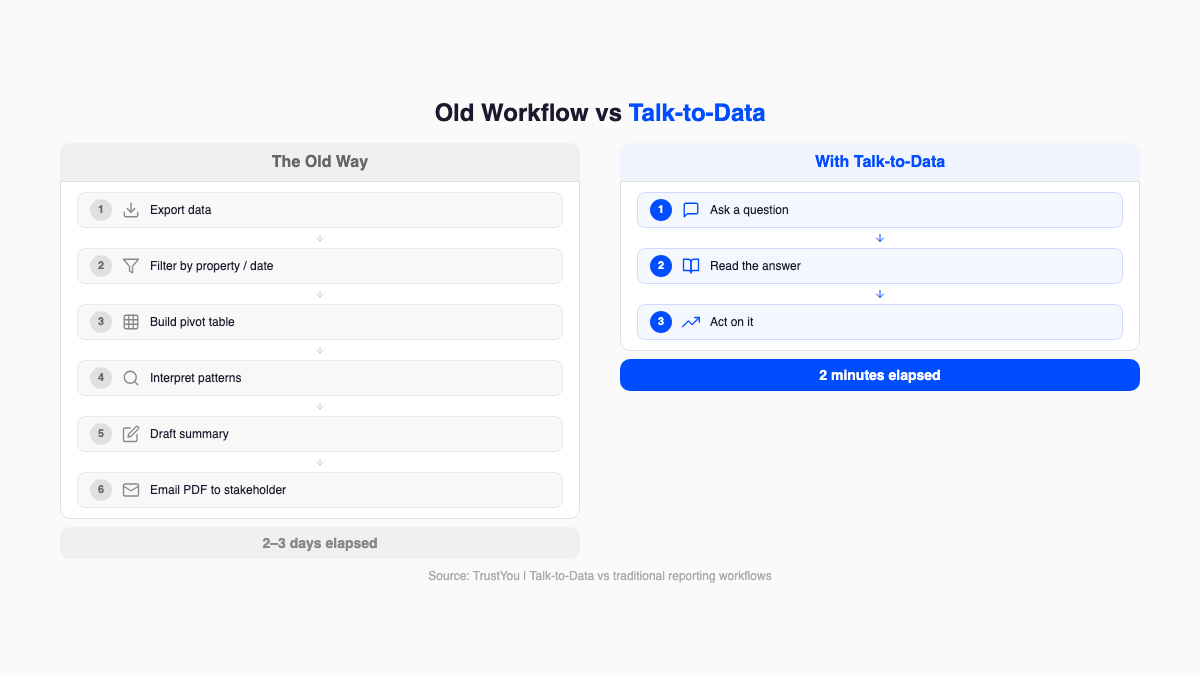
The old workflow: export data, filter by property and date, build a pivot table, interpret the patterns, draft a summary, email it to the stakeholder. Elapsed time: two to three days, if someone has bandwidth.
The new workflow: ask the question, read the answer, act. Elapsed time: two minutes.
Seven Questions Your Team Should Be Asking Right Now
The power of natural language querying isn't just speed. It's the questions that never get asked because they'd take too long to answer manually. Here are examples that map to real decisions across operations, marketing, and revenue:
For Operations and Guest Experience:
- "What are the top three complaints at our Munich properties this quarter compared to last quarter?"
- "Which properties have seen a decline in breakfast satisfaction scores over the past 90 days?"
- "How does guest sentiment about cleanliness at our city-center hotels compare to our airport hotels?"
For Marketing:
- "What are guests praising most at our top-rated properties? Give me the language they use."
- "How does our guest sentiment for 'value for money' compare to our competitive set in Barcelona?"
For Revenue and General Management:
- "Which properties have the biggest gap between our review scores and our comp set?"
- "Show me the correlation between response time to reviews and overall rating improvement across the portfolio."
Each of these questions, asked manually, represents hours of work. Asked through Talk-to-Data, they take seconds, and the answers come with the source data attached, so your team can drill into the specifics.
What Makes This Different from a Dashboard
Dashboards show you what you've already configured them to show. They're excellent for monitoring KPIs you've defined in advance: average review score, response rate, NPS trend. But they can't answer a question you haven't pre-built a widget for.
Natural language querying flips the model. Instead of building the report and then reading it, you start with the question and the system builds the answer. That distinction matters because the most valuable insights are often the ones nobody thought to set up a dashboard for.
A GM notices a spike in negative reviews at one property and wants to know if it's a seasonal pattern or something new. A marketing director preparing for a board presentation needs to compare sentiment trends across regions, by specific topic, for a specific date range. A revenue director wants to know whether properties with faster review response times show higher repeat booking rates.
None of these are standard dashboard views. All of them are questions Talk-to-Data handles in real time.
The Data Layer Underneath
Natural language querying is only as useful as the data it sits on top of. TrustYou CXP aggregates guest feedback from 80+ review sites, custom surveys (post-stay, in-stay, and pre-stay), and competitive benchmarking data, all unified, categorized by topic, and scored for sentiment.
That means when you ask a question, the answer draws from your full feedback ecosystem, not just one source. Review data and survey data together. Your properties and your competitors side by side. Current performance and historical trends in the same response.
For hotel groups operating across multiple brands, markets, or property types, this is the difference between fragmented signal and connected intelligence. One question, one answer, all sources.
What This Means for How Your Team Works
The real impact isn't the technology itself; it's what happens when the people closest to the guest experience can get answers without filing a request or building a report.
Quality managers stop spending Monday mornings on spreadsheets and start spending them on action plans. GMs walk into owner meetings with specific, current data instead of gut feel and anecdotes. Marketing teams pull guest language for campaigns directly from the feedback data, in the guests' own words. Revenue directors identify the properties where experience gaps are costing bookings, and quantify the impact.
When the friction between a question and its answer drops from days to seconds, the volume of questions goes up. And that changes how an organization uses guest intelligence: from a backward-looking reporting function to a forward-looking decision tool.
That's the shift. Not more data. Not better dashboards. The ability to have a conversation with your guest feedback -- and get an answer you can act on before the moment passes.
Stop exporting. Start asking.
See how TrustYou CXP's Talk-to-Data turns guest feedback into instant, actionable answers for your team.
Explore TrustYou CXP →Related Reading
- Explore Customer Experience Platform
- Learn why hotels that respond to every review outperform those that don't
Frequently Asked Questions
What is Talk-to-Data in TrustYou CXP?
Talk-to-Data is TrustYou CXP's natural language querying capability that lets hotel teams ask questions about their guest feedback in plain English and receive instant, structured answers. It queries across review data, survey responses, and competitive benchmarks simultaneously, with sentiment breakdowns and property-level comparisons included in every response.
What data sources does Talk-to-Data query?
TrustYou CXP aggregates guest feedback from 80+ review sites (including Google, Booking.com, and TripAdvisor), custom post-stay and in-stay surveys, and competitive benchmarking data. Talk-to-Data queries all of these sources in a single response, giving hotel teams a unified view of guest sentiment.
How is natural language querying different from a guest feedback dashboard?
Dashboards display pre-configured KPIs and require manual report building for ad hoc questions. Natural language querying lets you ask any question about your feedback data and get an immediate answer -- no exports, no pivot tables, no waiting for a BI team. The difference is the ability to explore data on demand rather than monitoring only what you've already configured.
Who on a hotel team benefits most from AI guest feedback analytics?
Guest experience managers, GMs, marketing directors, and revenue leaders all use Talk-to-Data for different purposes: identifying operational issues, preparing board presentations, pulling guest language for campaigns, and benchmarking against competitors. Any role that makes decisions based on guest signal benefits from instant access to the data.
Can Talk-to-Data compare my properties against competitors?
Yes. TrustYou CXP includes competitive benchmarking data, so you can ask questions like "How does our breakfast sentiment compare to our comp set in Berlin?" and receive a direct comparison with sentiment scores, topic breakdowns, and trend data.